
Today, it no longer comes as a surprise to see hybrid supercars approaching the 1,000 hp mark, figures that until very recently were reserved for extremely limited-production hypercars with prices easily exceeding one million euros.
Hybrid technology has firmly established itself in the luxury supercar industry, and it is now almost unthinkable for a major manufacturer to launch a new model without combining an internal combustion engine with one or more electric motors. This formula not only allows for increasingly spectacular power figures, but also makes it possible to achieve them without sending prices soaring, bringing performance levels that were once out of reach closer to a broader audience within the segment.
Ferrari has been no exception to this evolution. Its first step came in 2013 with the LaFerrari, the first hybrid model in the brand’s history. It combined a naturally aspirated 6.3 litre V12 producing 800 hp with a 163 hp electric motor, delivering a total output of over 960 hp. However, it was not a plug-in hybrid and its electric motor could not operate independently, in addition to being an extremely limited production model.
The real turning point arrived in 2019 with the Ferrari SF90 Stradale, the brand’s first series produced plug-in hybrid. Capable of covering short distances in fully electric mode, it marked the beginning of a new era in Maranello. That evolutionary path continued in 2022 with the arrival of the Ferrari 296 GTB, the second plug-in hybrid from the Cavallino Rampante and, for many, the start of a new design and driving philosophy.
Today, the SF90 Stradale and the 296 GTB stand as the two main flagships of Ferrari’s hybrid era. In our Drive Me Barcelona fleet, we have a Ferrari 296 GTB, and in this article we explain how these two models differ, offering a clear and detailed overview of the characteristics that set each one apart.
Power and performance
Although both models share the distinction of being the only plug-in hybrids from Maranello and it might seem that they use a similar powertrain, the reality is quite different. It is precisely in their technical approach where the greatest differences between the SF90 Stradale and the 296 GTB can be found.
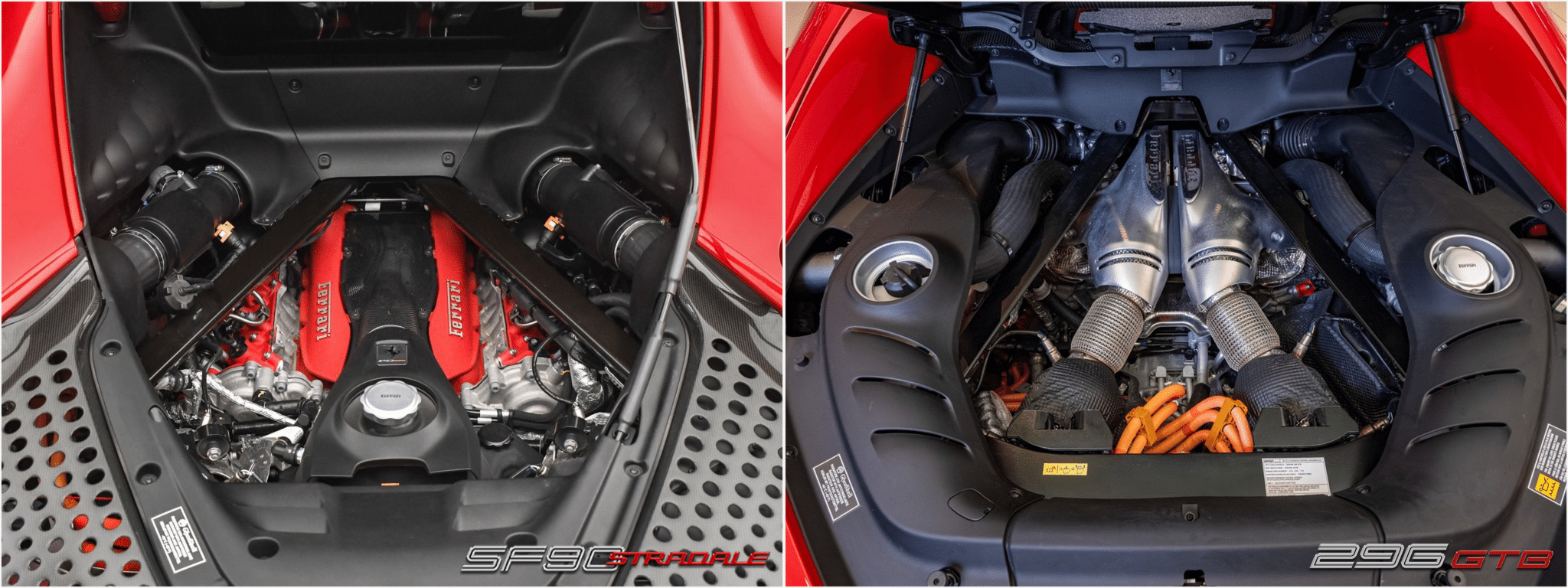
The Ferrari SF90 Stradale combines a 3.9 litre twin turbo V8 producing 780 hp and 800 Nm of torque with three electric motors. One is located on the rear axle and two on the front axle, delivering a combined output of 220 hp. Thanks to this configuration, the SF90 features all wheel drive and a total system output of 1,000 hp, allowing it to accelerate from 0 to 100 km/h in just 2.5 seconds, reach 200 km/h in only 6.7 seconds and achieve a top speed of 340 km/h.
The Ferrari 296 GTB, on the other hand, is the first road going Ferrari to be powered by a 2.9 litre twin turbo V6 with a 120º bank angle. This new six cylinder architecture, with its wide V layout and the forced induction system housed within it, is directly derived from Formula 1, where Ferrari has been using this same configuration in its single seaters since 2014. The V6 engine alone produces 663 hp, complemented by an electric motor mounted at the rear that adds a further 166 hp. Together, they deliver a total output of 830 hp and a maximum torque figure of 740 Nm, sent exclusively to the rear axle, unlike the SF90, which features all wheel drive. With these figures, the 296 GTB accelerates from 0 to 100 km/h in 2.9 seconds, reaches 200 km/h in 7.3 seconds and tops out at 330 km/h.
Despite their very different mechanical concepts, both models do share some key elements. Each features a rear mid engine layout and uses the same eight speed dual clutch transmission. In the case of the 296 GTB, this gearbox has been further refined to deliver a sharper and more immediate response.
Two designs with distinct philosophies
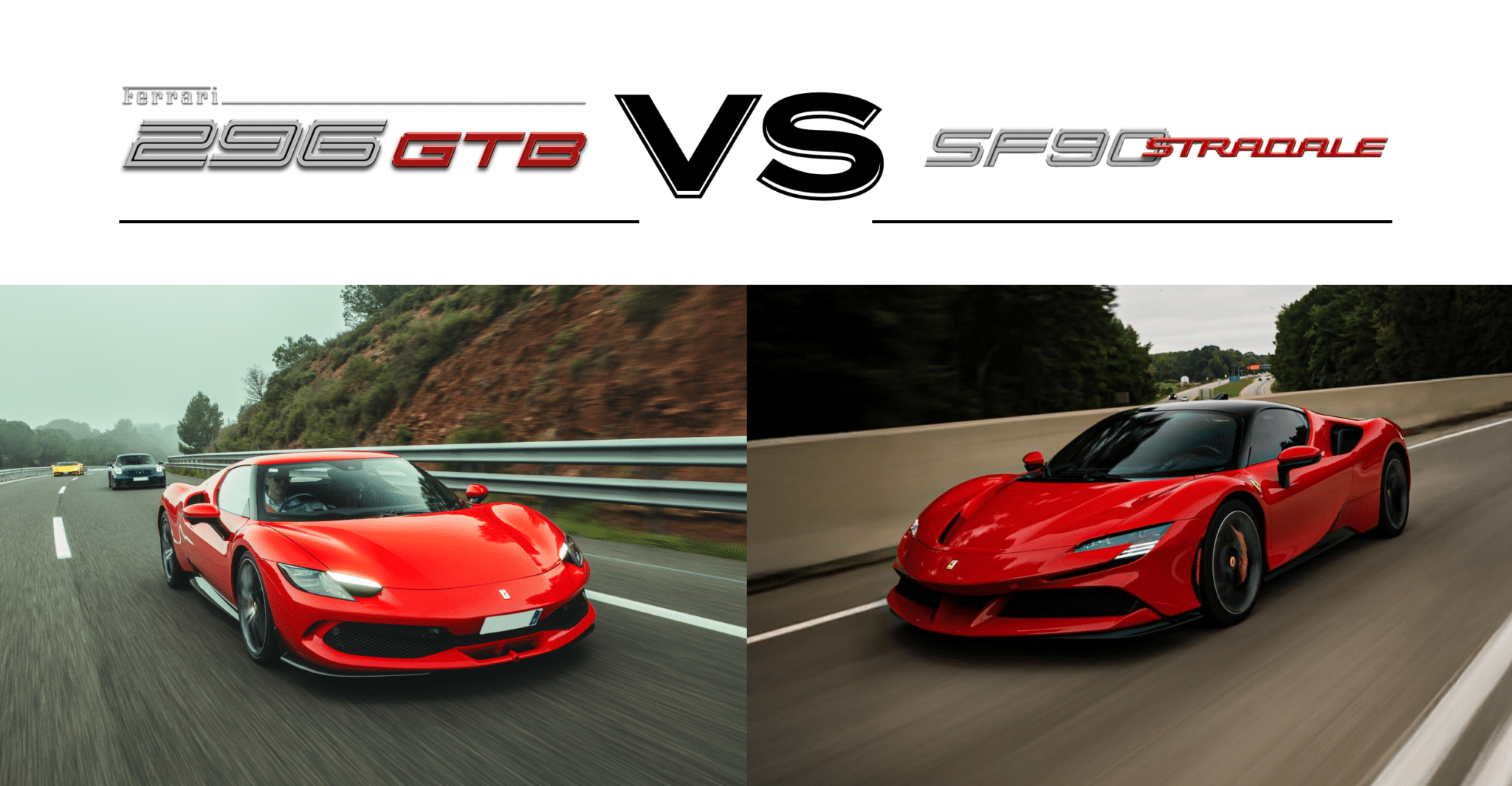
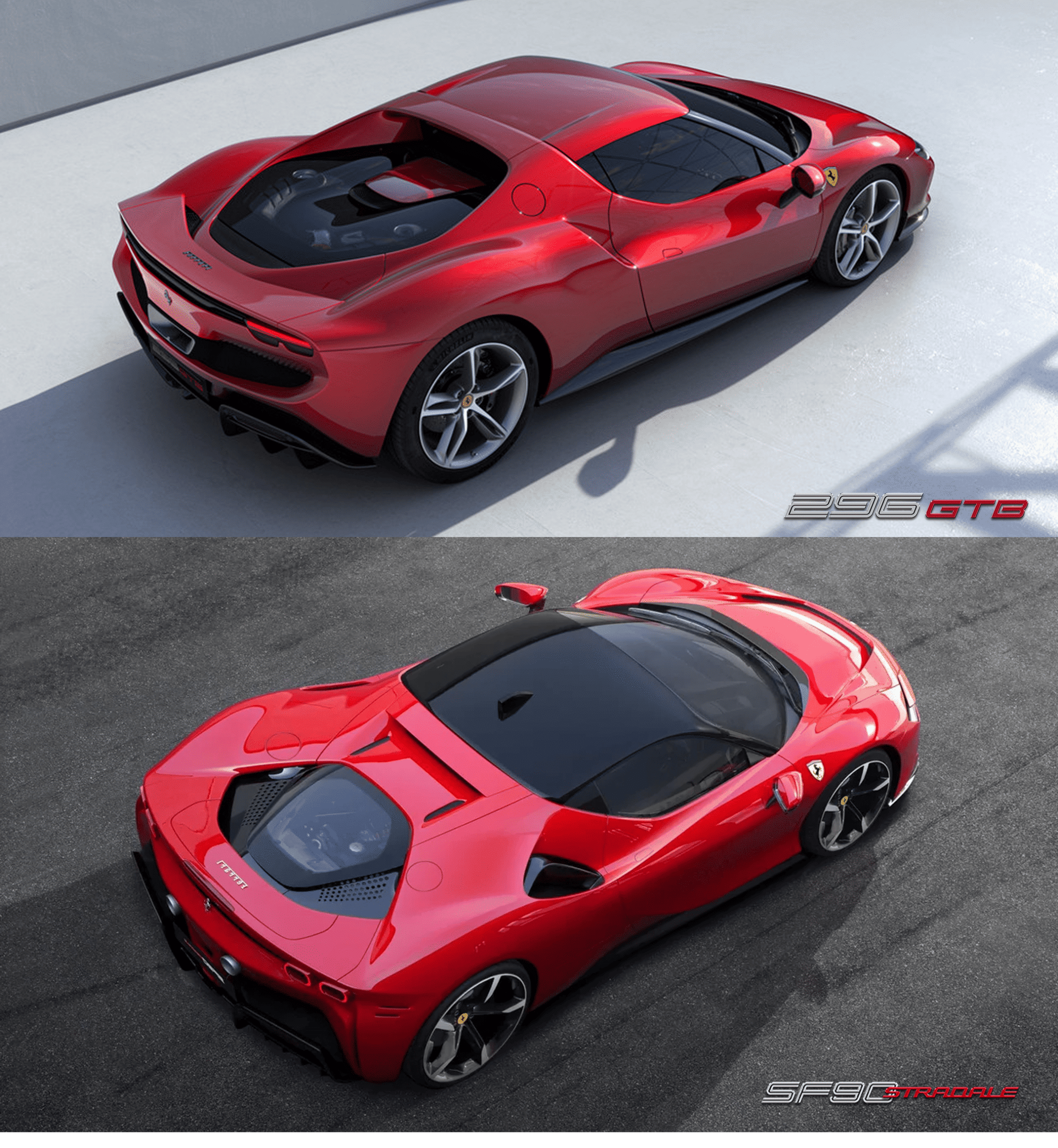
The exterior design of the Ferrari SF90 Stradale and the Ferrari 296 GTB is another area where the two models differ most clearly. Both share a low and aggressive stance, a rounded front end and large air intakes, but beyond these general traits, each adopts a clearly differentiated design approach.
The Ferrari SF90 Stradale draws inspiration from models such as the 488 GTB, the SP38 and, above all, the exclusive J50. The front end features a rounded silhouette with sharply defined lines, highlighted by a bonnet that flows down towards a V shaped opening reminiscent of the F8 Tributo. On either side sit slim, sharply styled twin headlights with a C shaped lighting signature. The look is completed by a front bumper with two large integrated air intakes and a central section finished in black.
In profile, the design closely recalls the 488 GTB and the F8 Tributo, with large air intakes integrated into the side pontoons. These are slim and elongated, housing multiple internal ducts, each with specific functions such as cooling, air intake and aerodynamic flow management. The rear is where the influence of the J50 is most evident. The engine cover, finished in black, does not extend continuously into the roofline but instead sits separate and slightly recessed, a distinctive feature of the model that inspired it. The rear end is completed by two centrally mounted, high positioned exhaust outlets, along with a fixed rear wing and a carbon fibre diffuser very similar to that of the 296 GTB. The design is rounded off by four square shaped rear lights that extend towards the sides.

The Ferrari 296 GTB, by contrast, showcases a more compact design, particularly noticeable in its short and sharp front bumper, which remains purposeful without being excessively low. Its styling takes inspiration from the 1963 Ferrari 250 LM, blending sporty lines with clean, highly refined surfaces. The front is defined by a large central air intake, a pronounced carbon fibre splitter and a long bonnet that visually stretches the silhouette. The teardrop shaped headlights integrate air ducts that channel airflow directly to the front brakes for cooling.
The side profile flows with smooth curves, without the aggressive lines or sharp cuts seen on the SF90 Stradale. It also features large side air intakes, although these are integrated more discreetly and play a less dominant visual role than on the SF90, prioritising overall aesthetics without sacrificing aerodynamic function. At the rear, the design is very flat and slightly concave, maintaining a consistently low height. One of its most distinctive elements is the downward sloping roofline which, as on the SF90, does not connect seamlessly with the engine cover. In the case of the 296 GTB, this cover is a glass panel with an arched shape that reveals the V6 engine beneath. The rear is completed by an active central rear wing housed between the tail lights, along with a single centrally mounted exhaust outlet positioned high up.
Two virtually identical interiors
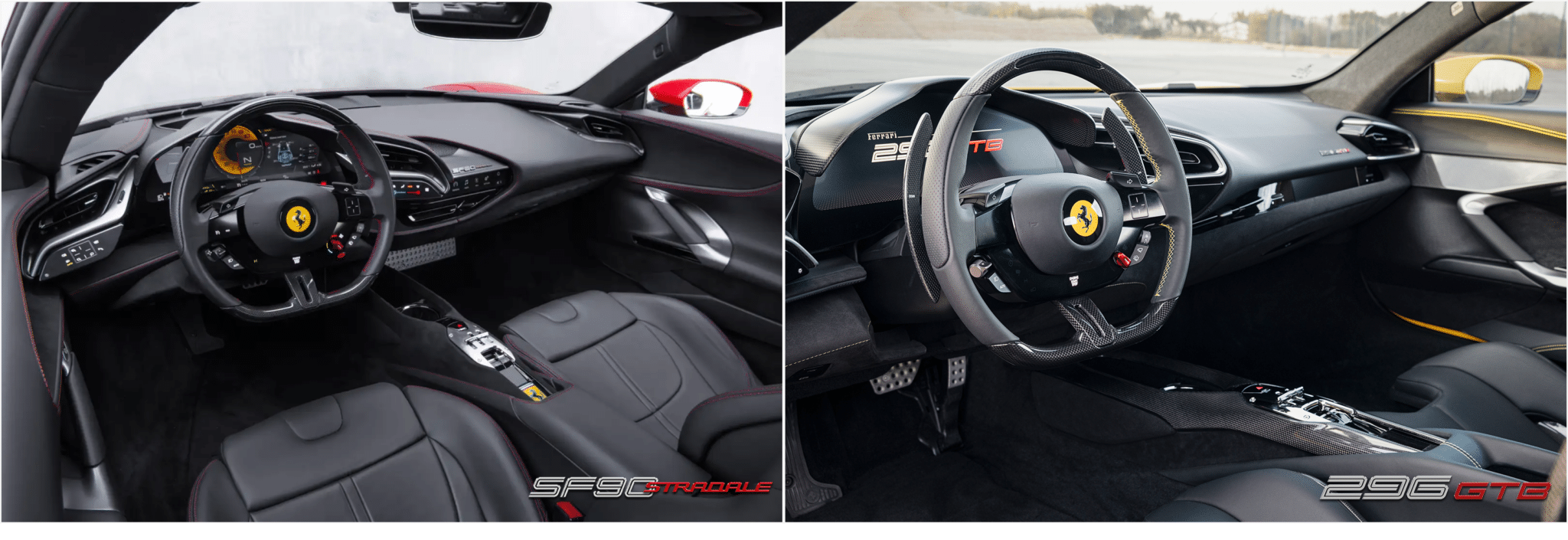
Ferrari has opted for a shared interior layout for both models, with very few differences between them. The cabin features a minimalist and sporty design, dominated by a large 16 inch digital display positioned behind the steering wheel, which acts as the instrument cluster. Fully configurable, it allows the driver to view real time telemetry and driving data, as well as manage the infotainment and navigation systems.
Both the SF90 Stradale and the 296 GTB also feature a second display for the passenger, which shows vehicle information such as engine speed and road speed, and allows basic control of multimedia and navigation functions. The only significant difference between the two interiors lies in the position of this screen. In the SF90 Stradale it is located in the centre of the dashboard and slightly angled towards the passenger, while in the 296 GTB it is positioned directly in front of the passenger. As a result, in the SF90 the driver can also interact with it, whereas in the 296 GTB it is reserved exclusively for the passenger.
In both models, digitalisation extends to every element of the cockpit, including the steering wheel. Traditional buttons and physical controls have been replaced by touch sensitive surfaces, with the iconic Manettino retained as the sole physical control. This provides access to the familiar driving modes: Wet, Sport, Race, Comfort, CT Off and ESC Off. Both cars also feature the new e-Manettino, a secondary selector used to manage the hybrid system through four electric modes. These include eDrive, which allows fully electric driving with a range of up to 35 kilometres, Hybrid, which automatically manages the combustion engine and electric motors with a focus on efficiency, Performance, which also operates in hybrid mode but prioritises performance, and Qualify, in which the electric motors deliver maximum output alongside the combustion engine.
Weight and dimensions
In terms of size, the Ferrari 296 GTB is significantly shorter than the SF90 Stradale. It measures 4,565 mm in length, which is 145 mm less than the SF90 Stradale’s 4,710 mm. The SF90 Stradale is also slightly wider, although the difference is minimal at just 5 mm, measuring 1,972 mm compared to the 1,968 mm width of the 296 GTB. As for height, both models are virtually identical, with the 296 GTB standing at 1,187 mm and the SF90 Stradale at 1,186 mm.
A more noticeable difference can be found in the wheelbase. It is worth highlighting that the 296 GTB has the shortest wheelbase of Ferrari’s current model range, at 2,600 mm, while the SF90 Stradale features a wheelbase of 2,650 mm. This difference has a direct impact on the dynamic behaviour of each car.
When it comes to weight, the hybrid system adds an additional load in both cases, prompting Ferrari to optimise the chassis and bodywork to minimise this extra mass. Both models use a chassis that combines carbon fibre and aluminium, along with various components made from lightweight alloys. In the SF90 Stradale, the three electric motors and the battery add 270 kg, while in the 296 GTB, which is equipped with a single electric motor and a smaller battery, the increase is limited to 99 kg. This difference is clearly reflected in their final figures. The SF90 Stradale has a dry weight of 1,570 kg, compared to 1,470 kg for the 296 GTB, placing the latter 100 kg below its larger sibling.
Finally, when looking at the power to weight ratio, the SF90 Stradale comes out on top with a figure of 1.57 kg per hp, compared to 1.88 kg per hp for the Ferrari 296 GTB.
Conclusion
After reviewing the main differences between the Ferrari SF90 Stradale and the Ferrari 296 GTB, it becomes clear that although they are the only plug-in hybrid models from Maranello and may initially appear very similar, in reality they are fundamentally different cars.
The first major distinction lies in their mechanical approach. The SF90 Stradale combines a V8 engine with three electric motors, enabling all-wheel drive, while the 296 GTB becomes the first road-going Ferrari to feature a V6 engine paired with a single electric motor, retaining a rear-wheel-drive layout. When it comes to power, both models deliver figures more typical of a hypercar than a supercar, with the SF90 Stradale producing 1,000 hp and the 296 GTB offering an equally impressive 830 hp.
From a design perspective, each model follows a clearly differentiated visual direction. The Ferrari SF90 Stradale conveys a more aggressive, technical and futuristic image, with sharp lines, highly sculpted surfaces and aerodynamics that play a visually dominant role. The Ferrari 296 GTB, by contrast, adopts a cleaner, more fluid and elegant design, with softer curves and more compact proportions, inspired by classic Ferrari models reinterpreted in a modern way. This aesthetic contrast reinforces the idea that, despite sharing plug-in hybrid technology, both cars are conceived to deliver very different sensations and driving experiences.
Both models reflect the direction Ferrari will follow in the coming years, with hybridisation as a central pillar. An evolution that makes it possible to achieve ever higher levels of performance without leading to a disproportionate increase in price.
At Drive Me Barcelona, you have the opportunity to get behind the wheel of the Ferrari 296 GTB and experience first-hand the unique sensations it delivers.
Would you like to drive the Ferrari 296 GTB? Check its availability here.